


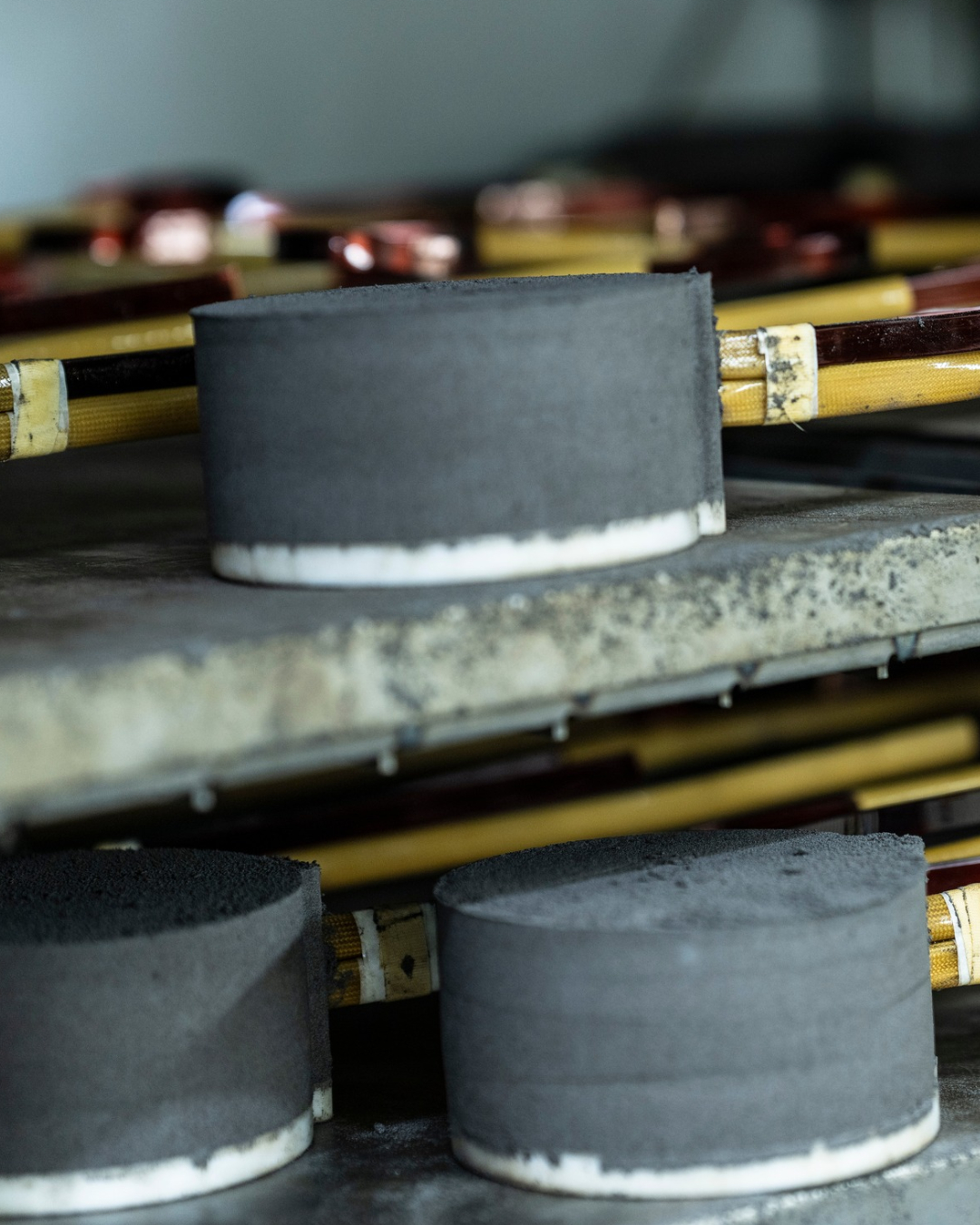
Challenges with Existing Technology
Traditional chokes are typically manufactured by winding a conductor either as an air coil or around an iron core, for example made of solid iron, laminated sheet metal, or ferrite. The winding is exposed around the core, which can cause magnetic leakage flux, energy losses, and heating of surrounding metal.
With this in mind, we have developed an innovative inductor designed to meet the demands placed on today’s power supply solutions and power quality. We call it ECOchoke®, and it is based on a unique design and manufacturing method combined with our in-house developed SM²C® material.
Our Material
Our SM²C® material, together with our manufacturing method, offers great flexibility compared to conventional materials and opens up design possibilities that are difficult or not practically feasible with existing technology.
The main advantages of SM²C® are:
- Low energy losses
- Good operating economy
- Great geometric freedom
- Significantly reduced size and weight, by up to 66%
- Nearly silent operation
- Frequency-independent performance, with maintained inductance up to 100 kHz
- High magnetic saturation, between 1.4–2.0 T
- Easy integration of cooling and temperature sensors
A High-Performance Inductor for Modern Power Electronics
The design provides low energy losses, stable inductance up to 100 kHz, and high magnetic saturation, while both size and weight can be significantly reduced. The flexibility of the SM²C® material also provides great geometric freedom, making it possible to adapt the inductor to the specific requirements and available space of the application.
Cooling solutions and temperature sensors can be integrated into the design, while the thermal coupling between winding and core contributes to efficient heat management.
The result is a compact, nearly silent, and highly adaptable inductor, particularly suited for applications involving harmonics, higher frequencies, or other requirements where conventional technology may have limitations.
The graphs show the inductance characteristics of EcoChoke® at 45 µH and 100 µH, as well as how the inductance changes with current. The characteristics show an advantage compared to a conventional choke.
Inductance Behavior Under Varying Current
The graphs show how the inductance of EcoChoke® changes with increasing current. Below is an example of the inductance characteristics for an EcoChoke® rated for 150 A and 100 µH.
EcoChoke® exhibits a gradual and controlled decrease in inductance, without a clear breakpoint where inductance drops sharply. A conventional choke, on the other hand, may show a more abrupt inductance drop as the core approaches magnetic saturation.
This gives EcoChoke® a smoother and more predictable inductance characteristic at high current levels.
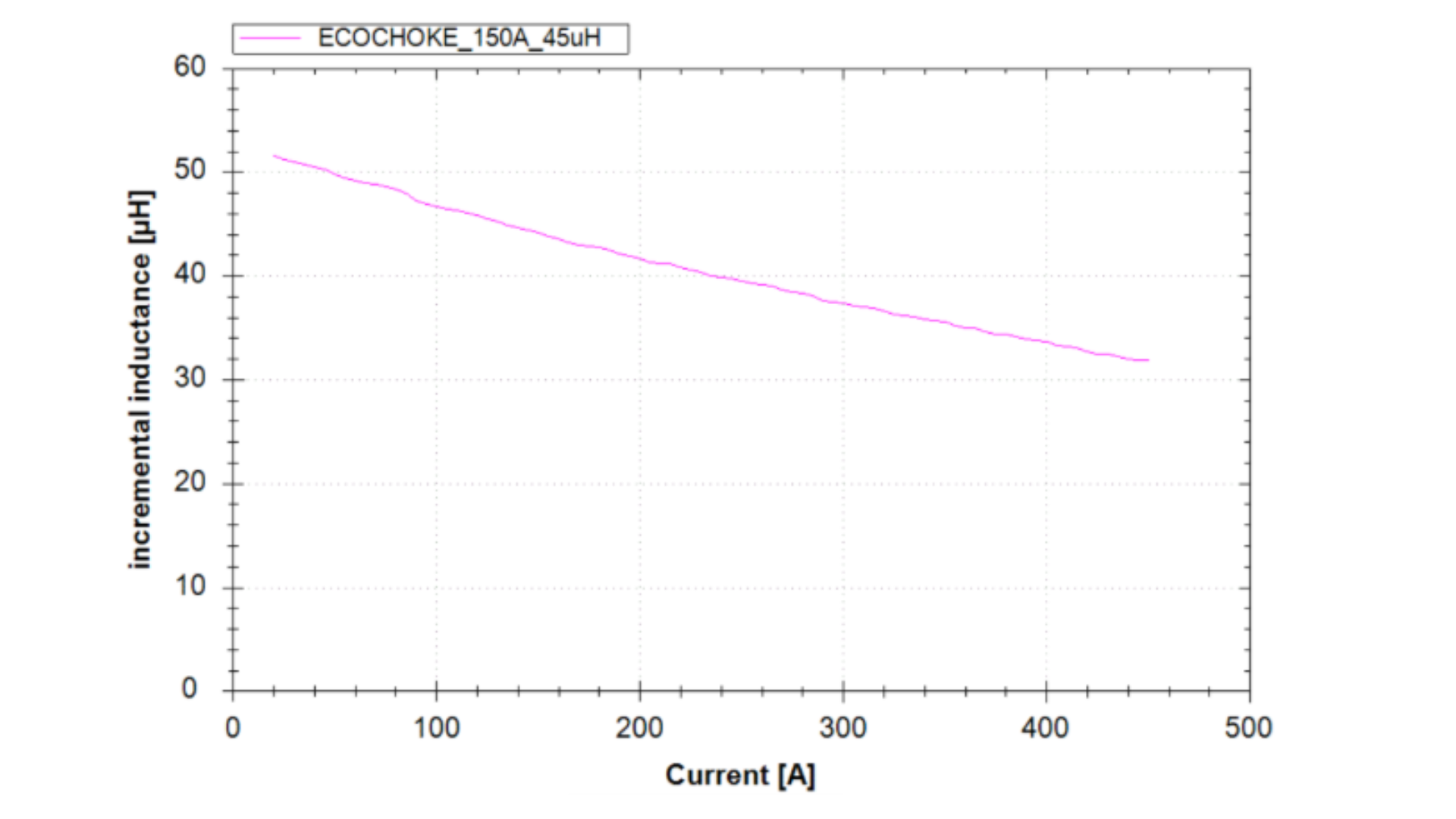
Inductance Characteristics for EcoChoke 45 µH
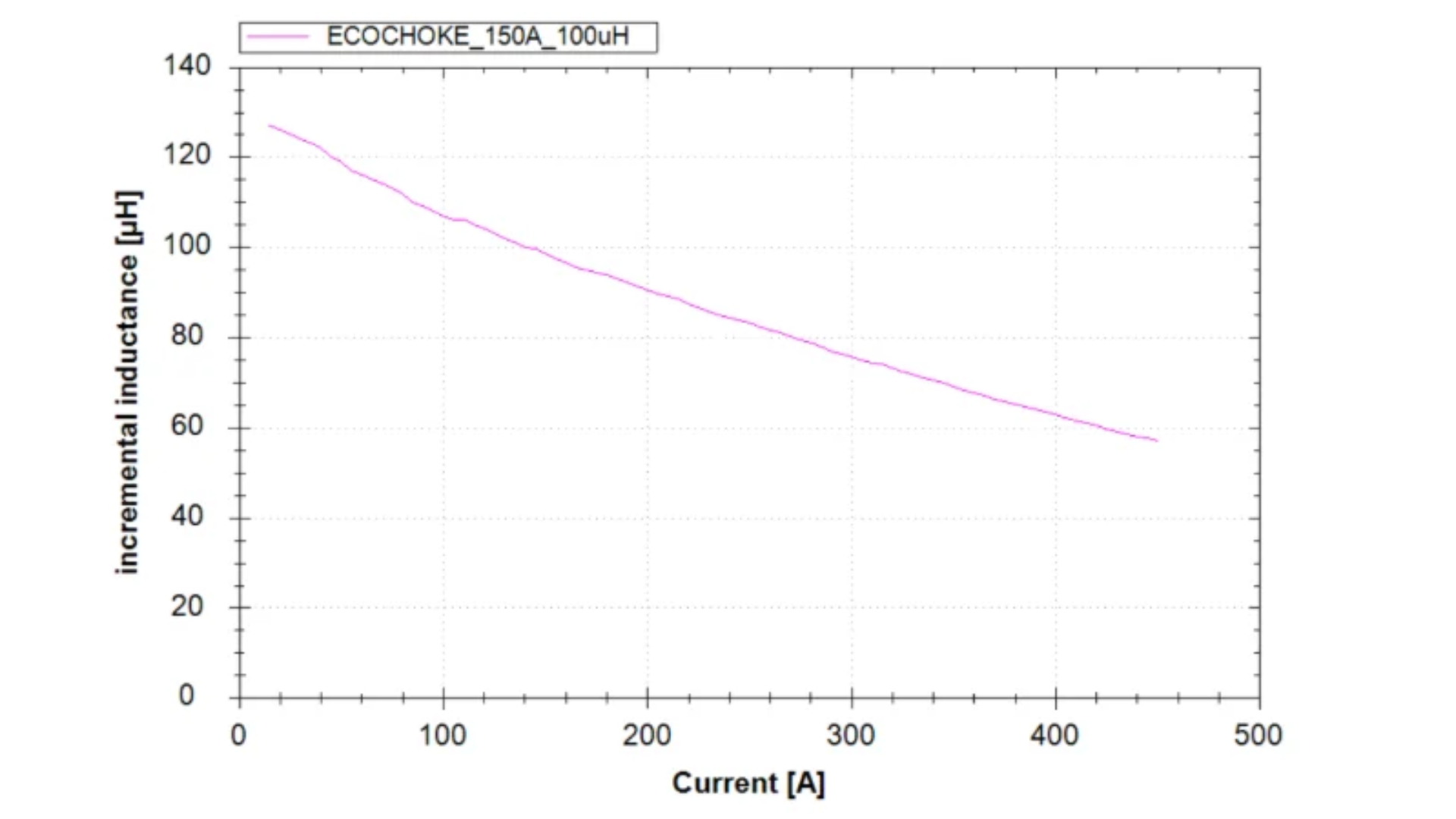
Inductance Characteristics for EcoChoke 100 µH
When Is ECOchoke® Suitable?
ECOchoke® can be particularly suitable:
When the fundamental frequency of the current is sinusoidal and exceeds 300 Hz.
- When the fundamental frequency of the current is lower than 300 Hz, for example 50 Hz or DC, and harmonics in the kHz range need to be effectively reduced. Especially when there is a requirement that the inductance remain the same at both the fundamental frequency and the harmonics.
- When there are requirements for reduced size or weight.
- When greater flexibility in the component’s geometry is needed.
- When a lower noise level from the inductor is desired.
- When fasteners or sensors need to be integrated into the product.
- When liquid cooling or cooling via a heat sink needs to be used, or when active cooling is not available.
- When the total energy content exceeds 10 mJ.
 Verified by Rami Al-Damouk
Development Engineer at Tramo.